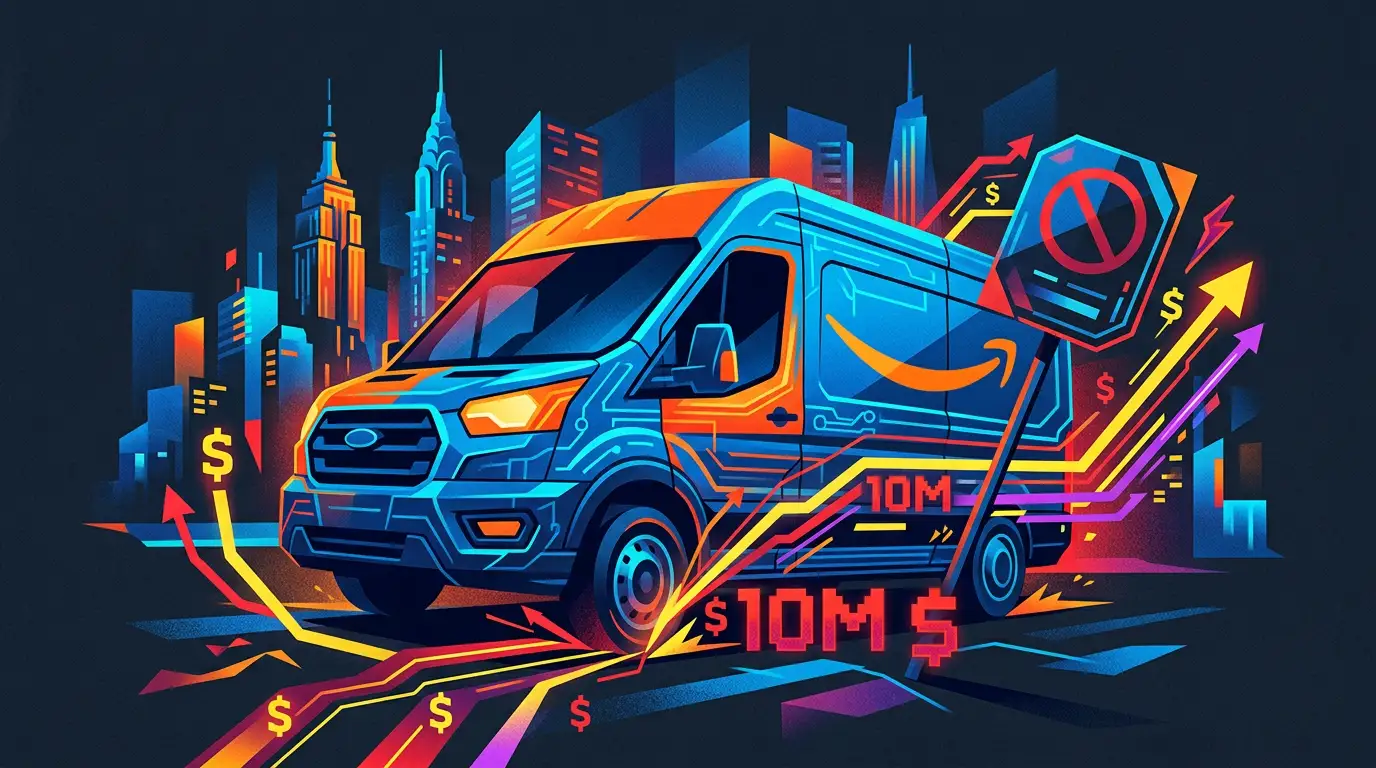
Amazon’s $10 Million Idling Problem
Amazon treats friction like a personal insult. Every millisecond shaved off a checkout process is a victory for the bottom line, but once those packages hit the gridlock of New York City, the algorithms run into a wall of old-fashioned, analog reality. That reality now has a specific price tag of $10 million.
The retail giant is reportedly sitting on a mountain of unpaid municipal fines linked to its massive delivery fleet. We are not talking about complex corporate tax disputes or high-speed chases. Instead, these are idling violations, the humble penalty for leaving a delivery van engine running while parked on a city street. To a single driver, a ticket is a nuisance. For a company of Amazon’s scale, these granular penalties have ballooned into a massive, accrued liability.
From a balance sheet perspective, $10 million is a rounding error for a company that measures quarterly revenue in the hundreds of billions. But as a data point, it is fascinating. It illustrates the growing tension between rapid e-commerce expansion and the physical limits of urban infrastructure.
New York City maintains some of the strictest idling laws in the country to curb noise pollution and protect air quality in neighborhoods where delivery vans are now as common as fire hydrants. The sheer size of this debt suggests a systemic failure to align high-speed logistics with local law.
Why keep the engine humming? In the high-stakes logistics game, every second is a metric. Shutting down and restarting a vehicle hundreds of times a day adds wear to the fleet and eats into the delivery window. There is also the matter of driver comfort (air conditioning is a necessity in a heatwave) and the security of the cargo.
To a fleet manager, idling is an efficiency. To the city, it is a public health hazard. This creates a scenario where fines become a predictable line item in the budget, essentially a "pay-to-play" fee for the privilege of using the city as a private loading dock.
We are reaching a point where the "cost of doing business" model no longer works for local governments.
Cities are realizing that if they do not enforce these regulations aggressively, they are effectively subsidizing trillion-dollar delivery networks with their own air quality. If these reports are accurate, the $10 million debt is a signal that the city is no longer willing to look the other way while the vans keep humming.
There is a telling silence from the stakeholders right now. We have no official word on whether Amazon is actively litigating these fines or if the debt is simply caught in an administrative backlog. In corporate finance, an unpaid $10 million debt is usually a sign of a fight. It is a common tactic for major corporations to use their legal departments to whittle down municipal penalties through sheer exhaustion.
But the lack of a formal response creates a vacuum of accountability. If the city fails to collect, the regulations lose their teeth. If Amazon pays without changing its behavior, the fines fail as a deterrent. This is the fundamental problem with using financial penalties to regulate Big Tech. When a company has more cash on hand than the municipality has in its entire enforcement budget, the power dynamic is permanently skewed.
New York City itself is part of the problem because it was never built for the age of one-day delivery. There are not enough loading zones, and the ones that do exist are usually occupied. This forces drivers into a perpetual state of double-parking and idling. It is a game of musical chairs where the chairs are all broken and the music never stops. Until the city and the corporation find a way to redesign the actual curbside experience, these fines will likely continue to pile up.
Is this debt a one-off anomaly or the start of a broader regulatory crackdown? If other major cities follow New York’s lead and start aggressively billing for environmental externalities, the cumulative impact on Amazon’s logistics margins could be significant. For now, it remains a stark reminder that even the most advanced digital companies must still answer to the laws of the physical world. The question is no longer how fast a package can arrive, but how much the company is willing to pay for the right to let its engines run while it gets there.