Everyone has a horror story about their first attempt at game development. It usually involves forty-eight hours of wrestling with environment variables and screaming at a compiler because of a missing bracket on line 402. We used to spend more time on the plumbing than the actual architecture. But an experimental new tool called Draw2Play suggests a future where we skip the setup hell entirely and move straight to the logic.
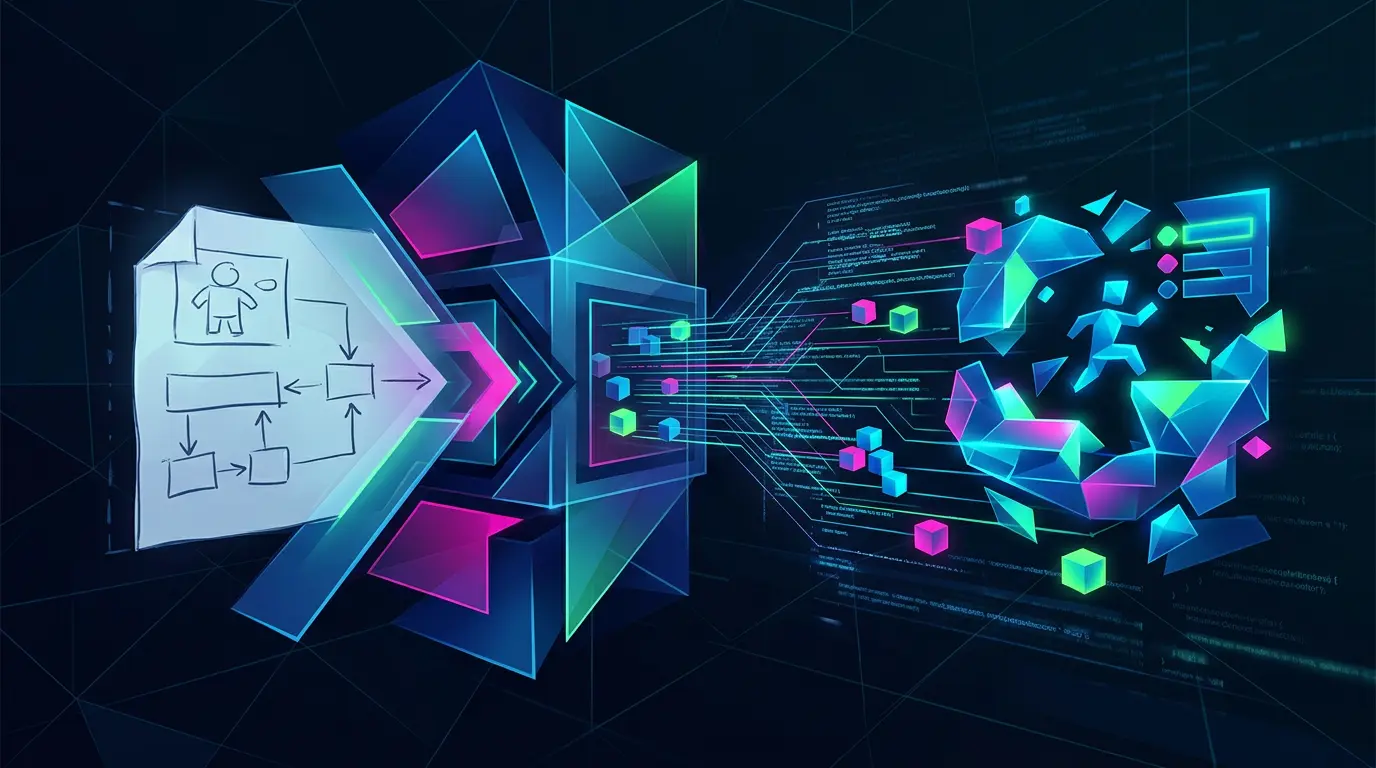
Created by an anonymous independent developer, Draw2Play is a fascinating look at the evolving Developer Experience. The premise is almost suspiciously simple. You draw a sketch, and an AI model converts that visual input into a functional, shareable mini-game. According to the creator, the entire pipeline from drawing to playability takes somewhere between 10 and 60 minutes.
In the world of development, we often talk about the "inner loop," which is the time it takes to see the results of a code change. Draw2Play isn't just tightening that loop. It is basically collapsing it. The developer describes the tool as a hybrid between a party activity, a creative toy, and a functional development tool. It is an attempt to bypass the heavy lifting of engines like Unity or Unreal for the sake of pure, rapid iteration.
The Shift from Coding to Conceptualizing
From a senior dev perspective, the most interesting part of this isn't necessarily the game itself. It is the abstraction layer. We have been moving toward higher levels of abstraction for decades, shifting from Assembly to C, and eventually to Python. Draw2Play represents a move toward what some call "Intent-Based Development." You aren't telling the computer how to render a sprite or handle a collision. Instead, you are showing it what you want, and the AI is inferring the mechanics.
When the friction between an idea and a prototype drops to under an hour, the cost of failure becomes almost zero. You can afford to be weird or random with your designs because you haven't invested three months into a C# script that handles jumping physics. As the developer put it, "It’s kind of half party activity, half creative toy, half ‘wait… this actually works?’"
That last part is the key.
The Black Box Problem
Of course, we have to look at the architecture, or the lack of transparency around it. The creator has been tight-lipped about the specific models or engines driving the backend. Is this an LLM generating boilerplate code on the fly? Is it a custom vision model mapping pixels to a pre-defined physics engine? Without knowing what is under the hood, it is hard to say if this is a scalable tool or just a very clever parlor trick.
There is also the question of "playability." The developer claims the tool works smoothly, but as any QA engineer will tell you, a game that works for five minutes is very different from a game that handles edge cases and complex logic. We are likely looking at simple physics-based prototypes rather than anything with deep narrative or complex state management. For now, it seems limited to the "toy" category. But even toys can signal where the industry is heading.
The Rise of Instant-Creation Media
We are entering an era of instant-creation media. We saw it with DALL-E for images and Suno for music. Now we are seeing the first real attempts to do it with interactive software. If Draw2Play can actually deliver a playable prototype in the time it takes to finish a latte, it changes how we think about the prototyping phase in professional studios. Imagine a lead designer sketching a level on a whiteboard and having a playable version ready for the team to test before the meeting even ends.
But there is a dark side to this speed. We run the risk of an influx of "AI-slop," which is low-effort, generated content that floods platforms like Itch.io or Steam. When the barrier to entry is lowered this significantly, the signal-to-noise ratio usually takes a nose-dive. We might find ourselves drowning in a sea of mediocre mini-games that lack the intentionality and soul of handcrafted design.
Final Thoughts from the Terminal
Draw2Play is a reminder that the role of the developer is shifting. We are moving away from being the ones who write every line of code and toward being the ones who curate and direct the AI's output. It is a transition from being a mason who lays every brick to being an architect who draws the blueprint and lets the machines do the heavy lifting.
As this tech matures, we have to ask ourselves a difficult question. In a world where everyone can build a game in an hour, what will actually make a game worth playing? When the technical challenge of development disappears, the only thing left that matters is the strength of the original idea. If your game can be generated by a sketch, is the sketch the true art, or is the AI just a very expensive pencil?