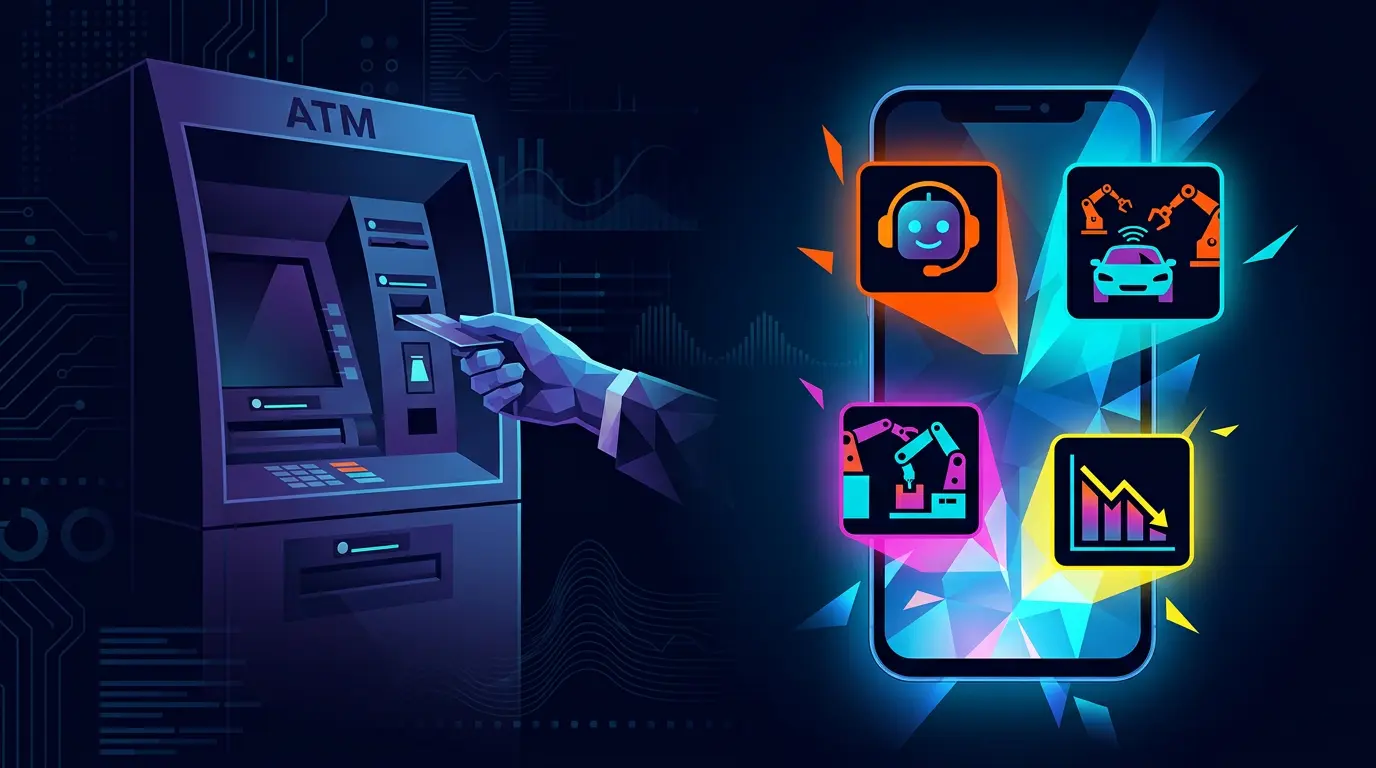
For decades, the automated teller machine was the original boogeyman of the labor market. It was the grey, metallic monolith that promised to turn bank tellers into a historical footnote, right alongside town criers and switchboard operators. If you lived through the 80s or 90s, the narrative was settled: the robots were moving in, and the humans were getting the pink slip.
Except, history had a different plan.
If you look at the data from the peak of the ATM rollout—roughly 1980 to 2010—you’ll find a reality that feels almost broken. Instead of cratering, the number of bank tellers in the United States actually climbed. This wasn't some weird statistical glitch; it was a masterclass in the counterintuitive way technology actually reshapes how we work. The ATM didn't kill the job. It acted as an industry-wide accelerant.
The Counterintuitive Math of the Branch
To understand why tellers didn’t vanish the moment the machines arrived, you have to look at the "unit economics" of the local branch. Before the ATM, running a bank was a massive, labor-heavy grind. You needed a small army behind the counter just to handle the basic rhythm of withdrawals and deposits. It was slow, it was expensive, and it limited where banks could afford to exist.
When ATMs went mainstream, they effectively commoditized those basic transactions.
But instead of pocketing the savings and firing the staff, banks did something more aggressive: they expanded. Because it was suddenly cheaper to operate a single location, banks started planting storefronts on every other street corner. The sheer volume of branches exploded.
While the number of tellers per branch dropped, the total number of tellers grew because there were simply more doors to walk through. By lowering the barrier to entry for retail banking, the ATM forced a shift in what a teller actually did. They stopped being human cash dispensers and became relationship managers—people who could help you open an account, resolve a messy error, or talk you through a mortgage.
The Coal Engine in the Lobby
Economists call this the Jevons Paradox. It’s an observation from the 19th century, when William Stanley Jevons noticed that as steam engines became more coal-efficient, England didn’t use less coal. It used significantly more. The efficiency made the resource so cheap and so valuable that it fueled an entire industrial revolution.
In this scenario, the ATM was the efficient engine.
For thirty years, technology and human labor lived in a strange, symbiotic harmony. The industry grew, the jobs evolved, and the headcount stayed high. The teller’s role shifted from counting pennies to selling financial services. It was a win-win that lasted until the world moved from the street corner to the pocket.
The iPhone Inflection Point
If the ATM didn’t kill the teller, why does your local branch now feel like a ghost town? The culprit isn't the machine built into the wall; it’s the glass slab in your hand.
The introduction of the iPhone in 2007, and the subsequent explosion of mobile banking, represented a shift the ATM could never achieve. The ATM improved the branch experience, but it still required you to actually show up. It kept the physical world relevant.
Mobile banking is a different beast. When you can deposit a check by snapping a photo or move ten grand while sitting in a coffee shop, the "utility" of the branch starts to evaporate. We aren't just automating a task anymore; we’re deleting the destination. For the first time, we are seeing a genuine, sustained collapse in teller headcounts because the reason for the building itself is disappearing.
I recently walked into a branch in midtown Manhattan that felt more like a minimalist art gallery than a bank. There were two tablets, one person in a sharp suit, and zero lines. The friction of the physical world has been replaced by the seamlessness of the digital one, and that is where the labor expansion finally hits a wall.
The Saturation Threshold: A Lesson for the AI Era
This brings us to the uncomfortable question of our current moment. We are frequently told that AI will be like the ATM—a tool that handles the grunt work, makes us more efficient, and frees us up for "higher-value" tasks. In many sectors, that’s probably true. We are currently in the expansion phase, where the plummeting cost of intelligence is causing a massive spike in how much of it we consume.
But the bank teller’s story offers a sobering footnote.
Every technology has a saturation threshold. There is a point where efficiency stops growing the pie and starts eating it. The ATM was an expansion tool because it made physical banking more accessible. The iPhone became a replacement tool because it made physical banking unnecessary.
As we watch AI move from assisting coders to writing entire applications, or from helping writers to generating entire marketing campaigns, we have to ask which phase we’re in. Are we building a better steam engine that will require more coal, or have we just invented a way to skip the trip to the factory altogether?
The decline of the bank teller wasn't a slow bleed caused by automation; it was a sudden collapse caused by a change in where we choose to spend our time. The robots didn't take the jobs. We just stopped showing up to the places where the jobs were.