When you climb into your car, you probably go through the usual ritual: adjust the mirrors, sync the Bluetooth, and click the seatbelt. You almost certainly don’t think about the seat itself. We treat car seats like stationary furniture—static, dependable, and invisible. We operate under the unspoken contract that, in a disaster, the chair holding us will remain a fortress.
For half a million drivers, that contract just got canceled.
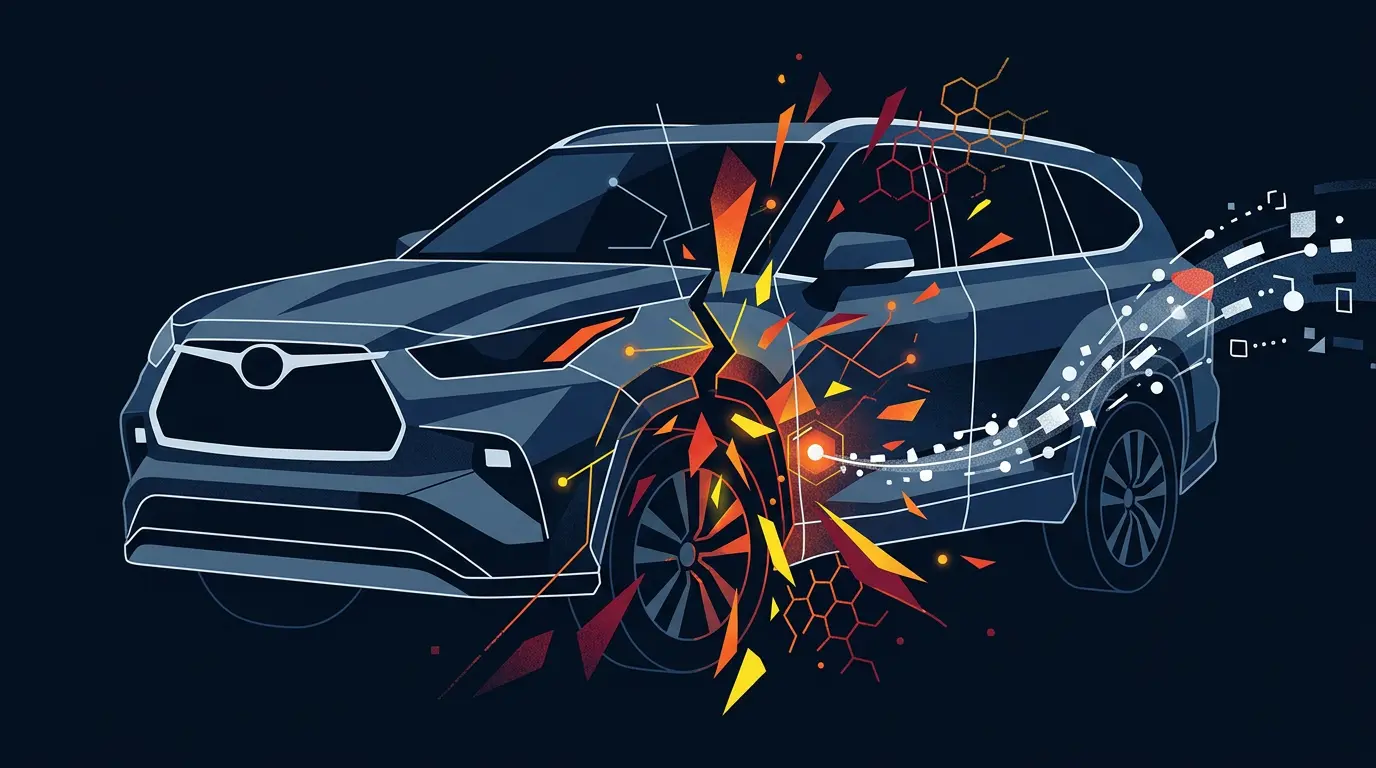
Toyota has officially issued a safety recall for approximately 550,000 Highlander SUVs. This isn't a minor software bug or a piece of plastic trim that might rattle on the highway. This is a fundamental structural defect. According to reports, the seat back assembly in these vehicles is prone to failure, meaning it may not properly restrain passengers during a collision. In the brutal, high-stakes physics of a car crash, that is a terrifying prospect.
The Logistics of a Half-Million Car Problem
When a manufacturer like Toyota calls back 550,000 vehicles, the logistical machinery required is staggering.
To put that number in perspective, imagine the entire population of Sacramento, California, all needing to visit a dealership at the exact same time. For the Highlander—a high-volume, family-oriented workhorse—this hits right at the heart of Toyota’s core demographic. These are the suburban commuters and parents who buy these cars specifically because they want to stop worrying about their car.
But a recall of this magnitude forces a massive operational pivot. Toyota now has to coordinate parts, labor, and communication across thousands of dealerships to ensure that every one of those 550,000 seat backs is inspected and reinforced. It’s a marathon of maintenance that will likely take months to resolve.
When Hardware Fails the Physics Test
The technical side of this story is a sobering reminder of how much we rely on basic mechanical integrity.
The seat back is the backbone of your safety system. In a collision, your seatbelt keeps you from flying forward, but the seat back is what prevents you from snapping backward or being displaced during secondary impacts.
Imagine leaning back in a cheap plastic lawn chair and feeling that sickening crack as the legs give way. Now, imagine that happening at 65 miles per hour while an airbag is deploying in your face. Toyota’s internal findings suggest the defect prevents the assembly from doing its one job: staying upright. As the official report notes, the defect can cause the seat back to "fail to restrain occupants properly, increasing the risk of injury."
In the engineering world, this is a failure of the "last line of defense." If the seat doesn't hold, every other safety feature—from the side-curtain airbags to the crumple zones—loses its effectiveness because the occupant is no longer where the car expects them to be.
The Manufacturer’s Burden
Toyota is now in full damage control mode. Under federal safety regulations, the manufacturer is obligated to fix the defect at no cost to the consumer. For owners, the immediate next steps are standard but urgent: check your Vehicle Identification Number (VIN) on Toyota’s recall website and wait for the official notification.
There is a certain irony here that becomes obvious when you cover the auto industry long enough. We spend so much time debating autonomous driving, oversized touchscreens, and AI-powered lane-keep assist, yet we are still occasionally tripped up by the basics of metal and hinges.
It’s a reminder that no matter how many lines of code you write, a car is still a two-ton kinetic object governed by the laws of motion.
Reliability in the Age of Complexity
This event raises a broader question about modern manufacturing. As vehicles become more complex, the pressure to produce them at scale increases. Toyota is a brand built on the philosophy of Kaizen, or continuous improvement—their assembly lines are usually the envy of the world. However, when you are moving 550,000 units of a single model, even a tiny error in the supply chain or a minor oversight in structural testing can balloon into a half-billion-dollar headache.
In an era where we are obsessed with the digital "brains" of our cars, this recall is a loud, metallic wake-up call. It proves that the physical "bones" of the vehicle are just as susceptible to error as any buggy software patch.
As we look forward, this situation underscores a vital habit for every driver: don't ignore the mail. We’ve become conditioned to treat manufacturer notices like junk mail, but when it comes to structural integrity, a brand's reputation for reliability isn't a substitute for proactive maintenance. Even the most dependable names in the business can have a bad day at the factory. The question is, are we paying enough attention to the hardware that literally has our backs?