The Real Estate Problem Stalling AI
Every AI researcher knows the silent dread of the "black box" problem. It isn't just about how a model arrives at a specific weight or bias. The real anxiety is about where the raw data actually lives while that model is learning. For years, the industry has marched under a cloud-first mandate, but that momentum is finally hitting a brick wall built of regulatory compliance and intellectual property theft fears.
The result is a graveyard of expensive science experiments. Many enterprise AI projects today are trapped in a cycle of perpetual testing because the legal department refuses to let sensitive data leave the building.
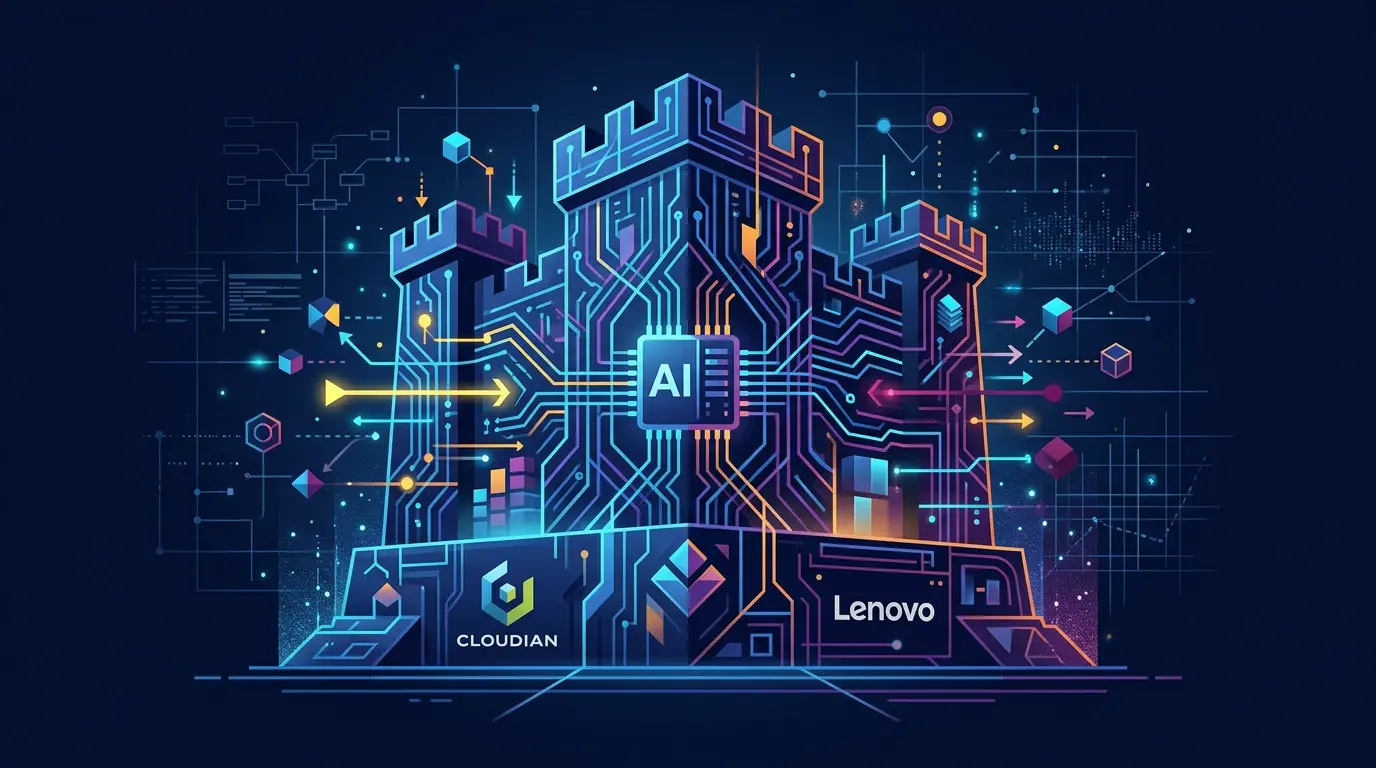
This friction is exactly what Cloudian and Lenovo are targeting with their latest collaboration. On March 16, 2026, Cloudian announced that its HyperScale AI Data Platform achieved the Lenovo Validated Design certification. While hardware certifications usually sound like dry technical housekeeping, this move signals a major shift in how we architect the next generation of private intelligence. It is a direct response to the realization that for AI to move from a parlor trick to a production reality, we have to solve the data residency problem once and for all.
Bridging the Gap Between Silicon and Storage
In the research world, we often obsess over the elegance of the transformer architecture or the efficiency of a specific optimizer. However, even the most sophisticated model is useless if the infrastructure underneath it is a chaotic mess of unoptimized components. This is what I call the integration tax. IT teams spend months trying to stitch together storage arrays and compute nodes, only to find that the bottleneck moves every time they scale.
The Lenovo Validated Design certification acts as a pre-approved blueprint. By certifying the HyperScale AI Data Platform on Lenovo's enterprise hardware, these two companies are essentially providing a plug and play environment for massive datasets.
Cloudian, which is based in San Mateo, California, is positioning this as a way to bypass the "bespoke" era of AI infrastructure. Instead of building a custom house from scratch every time you want to train a model, you are moving into a pre-wired, high-performance facility.
Why Your Infrastructure Is Your Intelligence
We need to stop thinking about storage as a passive bucket for bits. In a modern AI pipeline, storage is an active participant in the training process. High-performance workloads require massive throughput and ultra-low latency to keep expensive GPUs from sitting idle. If your data platform cannot feed the model fast enough, you are essentially paying for a Ferrari but driving it through a school zone.
More importantly, this partnership addresses the mandate for data sovereignty. In sectors like finance, healthcare, and the public sector, data residency is a legal requirement. You cannot simply upload a patient's genomic sequence or a bank's proprietary trading algorithm to a public cloud API and hope for the best.
The Cloudian-Lenovo solution keeps the data on-premises or within a tightly controlled private cloud environment. It allows researchers to maintain complete custody of their intellectual property while still accessing the scale required for deep learning. Moving petabytes of training data to the public cloud is often like trying to fill a swimming pool with a cocktail straw. It is slow, expensive, and eventually, the straw breaks.
Removing the Friction from the Deployment Pipeline
One of the biggest reasons AI projects stall during the pilot phase is the sheer complexity of the deployment. A researcher might have a brilliant model running on a single workstation, but moving that to a cluster that can handle terabytes of daily ingest is a different beast entirely.
The "deployment gap" is where most innovation goes to die.
By providing a pre-validated configuration, Cloudian and Lenovo are attempting to standardize the Private AI stack. This reduces configuration errors and provides architectural assurance that the system will actually perform as expected under heavy loads. While the current news does not provide specific performance benchmarks, the value here is in the predictability.
In the world of model training, predictability is often more valuable than raw speed. Knowing that your infrastructure will not collapse when you add the next hundred nodes allows teams to focus on the science rather than the plumbing.
The Future of the Private AI Era
As I look at the current trajectory of enterprise AI, it is clear that we are moving away from the "wild west" phase of cloud experimentation. We are entering an era where the CIO is just as concerned with data custody as the lead researcher is with model accuracy. The partnership between a storage specialist like Cloudian and a hardware giant like Lenovo represents a new baseline for what enterprise infrastructure should look like.
I have seen too many brilliant models fail because the underlying storage could not handle the IOPS required for distributed training. This certification is a step toward fixing that. It poses a provocative question for the industry. As regulators tighten their grip on AI data handling, will the "Validated Design" become the only viable path for enterprises that refuse to trade their data sovereignty for capability?
We are likely heading toward a future where the public cloud is for experimentation, but the private, validated stack is where the actual business of intelligence happens. The bridge has been built. Now we wait to see how many enterprises are ready to cross it.