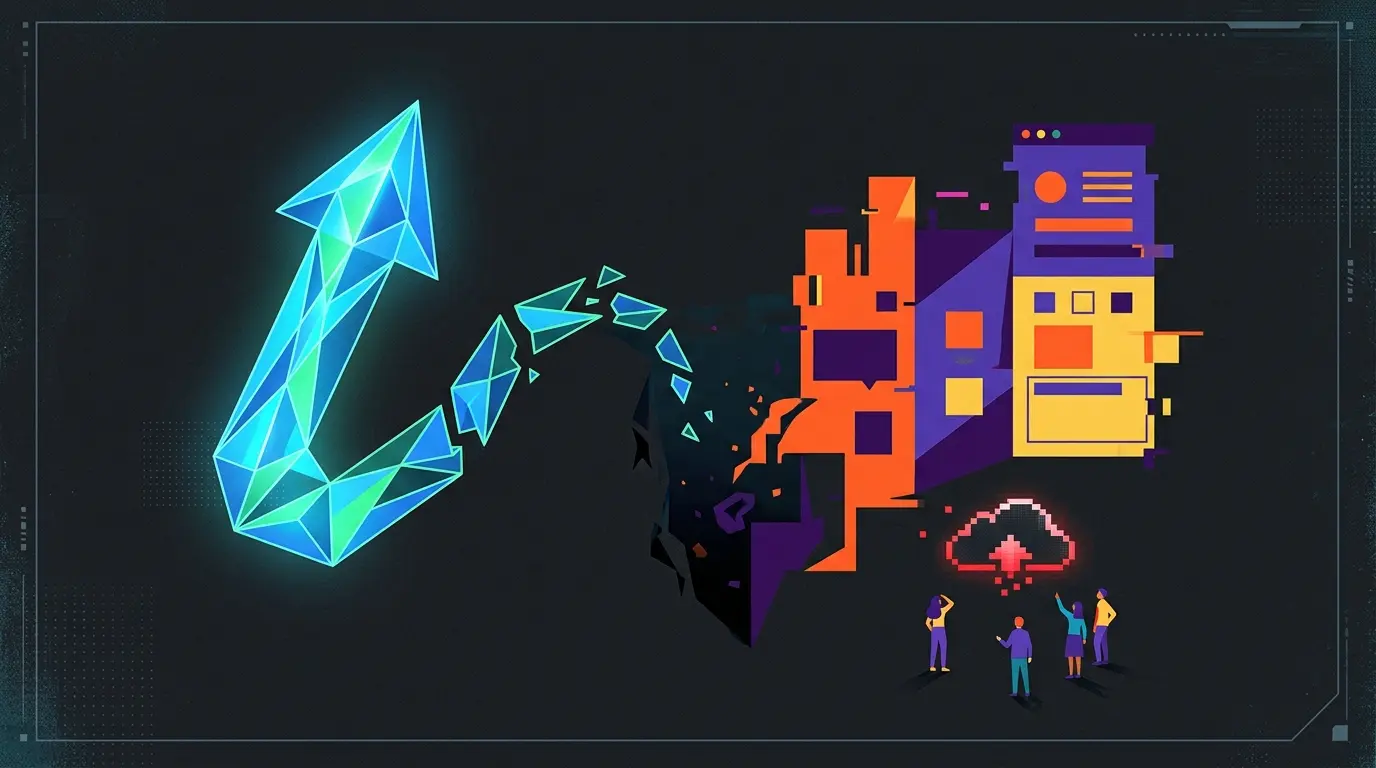
Every time you open a chat with a modern AI, you are essentially meeting a stranger. Even if you spent all night teaching it your coding style or your company hierarchy, the agent effectively lobotomizes itself the moment the session ends. It is the digital equivalent of Groundhog Day. Your assistant wakes up, forgets your name, and waits for you to remind it why it exists. This persistent amnesia is the primary barrier between a helpful chatbot and a truly autonomous partner.
Currently, developers try to patch this hole using a technique called Retrieval-Augmented Generation (RAG) or memory services like Mem0 and Zep. These tools act as a sort of external hard drive for the AI. When you talk, the system searches old logs, finds relevant snippets, and stuffs them into the current prompt.
It works, but the architecture is fundamentally broken for long-term scaling.
As the industry is starting to realize, starting from zero every single time is a recipe for failure. While current tools help, they rely on a constant loop of expensive inference calls just to function.
The Bottleneck: Why Memory Is Currently a Luxury
To understand why your AI forgets, you have to look at the grocery bill. Modern memory solutions require the LLM to do the heavy lifting of cognition. If an agent needs to learn a single new fact about you, it typically sends your message to a model like GPT-4 to extract that fact. The model notes that you prefer Python over Java and files it away in a database.
This creates a three-headed monster of inefficiency.
First, there is the cost. You are paying per token for a genius-level model to play secretary and file away notes. Second, there is the latency. Every time the agent has to think about what to remember before it even answers you, the delay grows. Finally, there is the dependency. Your agent cannot learn anything without pinging a cloud service. If the server goes down or the API price hikes, your agent loses its ability to grow.
In my experience researching model behaviors, the more we ask an LLM to manage its own context, the more its primary reasoning performance degrades. We are essentially asking a world-class philosopher to also act as a full-time filing clerk. It is an inefficient use of high-order intelligence.
Decoupling Cognition from Inference
The proposed shift in architecture involves building a cognitive layer that functions independently of the LLM. The goal is to move memory processing outside the expensive inference loop. Instead of asking the big model to extract facts, a separate system handles the learning. This layer would observe interactions, build user profiles, and identify important data points natively.
This isn't just a technical tweak. It is a move toward a biological model of intelligence. In humans, the hippocampus handles the encoding of long-term memories without requiring the constant, high-energy focus of the prefrontal cortex. By creating a dedicated layer for persistent learning, developers can create agents that are always on and always evolving. They become entities that grow through interaction rather than static models that occasionally read a summary of their past.
The Economic Case for Local Learning
The most immediate impact of this change is economic. By removing the LLM from the fact-extraction process, the cost of learning drops to nearly zero. Developers could build agents that remember every tiny detail of a user's life without blowing their budget on API credits.
There is also a massive privacy win here.
If the cognitive layer does not require a massive cloud-based LLM to process memories, it can run locally. Your personal history, your private data, and your habits could stay on your own hardware. The LLM would only receive the specific context it needs to answer a prompt, rather than being the engine that processes your entire life history into a database.
The Skeptic’s Corner: Can It Actually Reason?
As an AI researcher, I have to point out the missing pieces in this proposal. The concept is compelling, but the technical methodology remains a black box. We have to ask how a non-LLM system actually decides what is worth remembering.
Extracting facts from human language requires a high degree of nuance. If I say, "I'm tired of this weather," a sophisticated model knows I probably live in a place with a specific climate. A simpler system might just record that I was tired on a Tuesday. Without the deep semantic understanding of a large transformer, these cognitive layers might struggle with accuracy. They could end up filling a database with digital junk, making the RAG process even more cluttered than it is now.
We also lack empirical benchmarks. Until we see a head-to-head comparison between LLM-based extraction and this new layer, we cannot be sure if the cost savings are worth the potential loss in memory quality.
The Future of the Digital Companion
If we can successfully decouple memory from the expensive inference cycle, we change the nature of AI. We move away from the era of the disposable session and into the era of the lifelong digital companion.
Will the future of AI be defined by making models bigger and smarter? Or will it be defined by building better scaffolding around them? If this new cognitive layer delivers on its promise, the answer is likely the latter. We do not need a smarter philosopher. We just need a better filing cabinet that does not charge us by the page. The real question is whether these simpler systems can truly capture the complexity of human experience, or if we are stuck paying the token tax for the foreseeable future.