"Can it run Doom?"
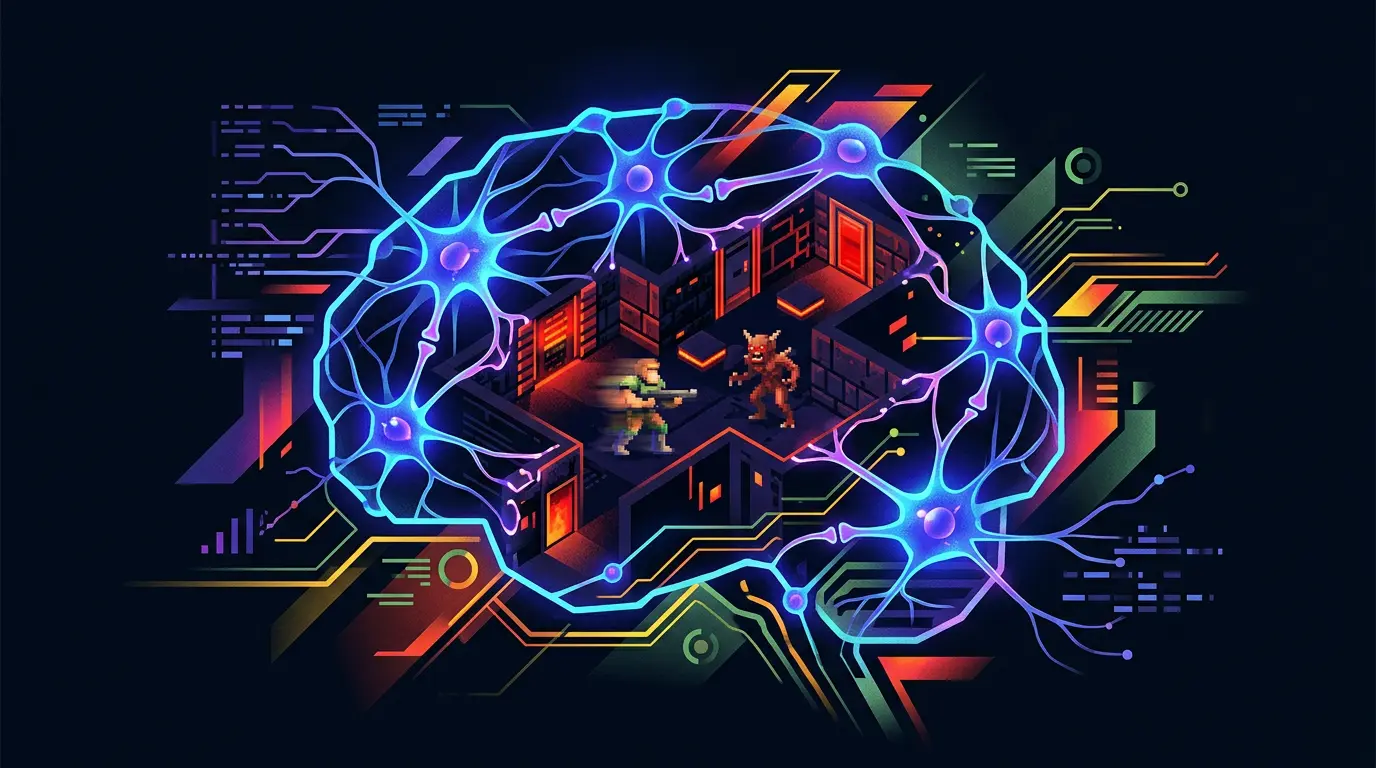
It is the ultimate litmus test for any new piece of hardware. We have seen the 1993 classic ported to everything from digital cameras to pregnancy tests, but the latest "rig" to tackle the pixelated corridors of Mars isn't made of silicon. It is a cluster of 200,000 living human brain cells sitting in a petri dish.
Cortical Labs, a startup working at the intersection of biology and tech, has successfully integrated these cells into a biological computing system. This isn't a simulation of neural pathways running on a high powered GPU. This is actual human biology performing computational work in real time. The cells are learning to move, aim, and shoot, marking a milestone that should make every AI researcher rethink the limits of our current models.
The Architecture of Wetware: Beyond the Chip
To understand why this matters, you have to look at the hardware. Traditional computers rely on the von Neumann architecture, which separates the processor from the memory. Information travels back and forth, creating heat and sucking up massive amounts of power. The biological computer developed by Cortical Labs, built on a glass chip, functions without a single silicon processor at its core.
Instead of logic gates and transistors, the system uses the innate plasticity of neurons. The cells are grown on a multielectrode array that acts as a bridge between the biological culture and the digital game. The game sends electrical signals to the cells representing the environment (where the walls are, where the enemies are) and the cells respond with their own electrical spikes. Those spikes are then translated back into in-game actions like turning or firing a weapon.
From a researcher's perspective, this is a masterclass in signal transduction. We are seeing a biological system organize itself to minimize "surprise" in its environment, a concept known as the free energy principle. The cells aren't just reacting. They are building a rudimentary internal model of the Doom world to achieve a specific goal.
Training the Dish: How Cells Learn to Shoot
The most impressive part of the experiment is the reinforcement loop. In a standard machine learning model, we use backpropagation to adjust weights over millions of iterations. With 200,000 human brain cells, the learning feels more visceral.
The system provides feedback to the cells. When they hit a target, they receive a predictable, organized electrical stimulus. When they miss, they receive a blast of chaotic, unpredictable noise.
Biological systems naturally seek order over chaos. Over time, the cells reorganize their connections to favor the actions that result in the organized feedback. According to reports from The Guardian, this allowed the culture to master basic navigation and combat. They aren't just twitching randomly. They are executing intent.
This highlights the sheer adaptability of biological intelligence. While a traditional AI model needs to be specifically architected for a task, these cells possess a level of fluid plasticity that silicon struggles to replicate. They are, quite literally, wired to learn.
The Efficiency Benchmark
If you spend any time looking at the massive energy requirements of modern LLMs, the efficiency of this biological setup is staggering. A high end AI cluster requires thousands of watts and complex cooling systems to keep from melting. A human brain runs on about 20 watts, which is roughly the power of a dim lightbulb.
A petri dish of 200,000 cells requires even less. It lives on a diet of glucose and salt water, yet it can perform complex spatial reasoning tasks that would require a significant amount of compute on a traditional server.
If we can find a way to scale this "wetware," we could see a fundamental shift in how we approach high density computing. We might stop building massive data centers and start cultivating biological processing hubs that are cooler, cheaper, and more reactive than anything we currently have in a rack.
The Ethical Frontier
Naturally, this development has sparked intense debate. A recent thread on Reddit captured the public's unease, with users asking the obvious question: "Should we be worried?" It is a valid concern that moves us out of the lab and into the realm of philosophy.
Currently, these cells are not sentient. They are a culture of neurons responding to stimuli, much like a reflex arc in a simple organism. They don't have a consciousness, they don't know they are playing a game, and they certainly don't have feelings about the demons they are shooting.
However, as we scale from 200,000 cells to millions or billions, the line begins to blur.
We are entering a period where our ethical frameworks for synthetic biology are lagging behind our technical capabilities. If a biological computer begins to show signs of complex learning or even rudimentary awareness, does it deserve rights? Is it a tool or a being? These are the questions we need to answer before this technology leaves the experimental phase.
The Wright Brothers Moment
This experiment is the Wright Brothers moment for biological computing. The flight was short and the plane was flimsy, but it proved that the sky was no longer the limit. By teaching a dish of cells to play Doom, Cortical Labs has proven that biology can be harnessed as a computational engine for complex, real time tasks.
We are looking at a future where the distinction between "artificial" and "natural" intelligence becomes increasingly irrelevant. The real test will be whether we can harness this biological plasticity to solve real world problems that silicon can't touch. We have spent seventy years trying to make machines act like brains. Perhaps the answer was to just use the brains themselves. The next few years will tell us if we are building a new class of tools, or if we are accidentally growing something much more complicated.