Most AI models today are essentially world-class guessers. They predict the next word in a sentence not because they have any grasp of reality, but because they have seen similar patterns billions of times. It is a high-stakes, expensive game of Mad Libs.
We have reached the limits of this brute force approach. The current industry standard, which relies on massive gradient descent across gargantuan datasets, is hitting a wall of diminishing returns. It is expensive, it is power hungry, and it results in models that often sound incredibly confident even when they are completely wrong.
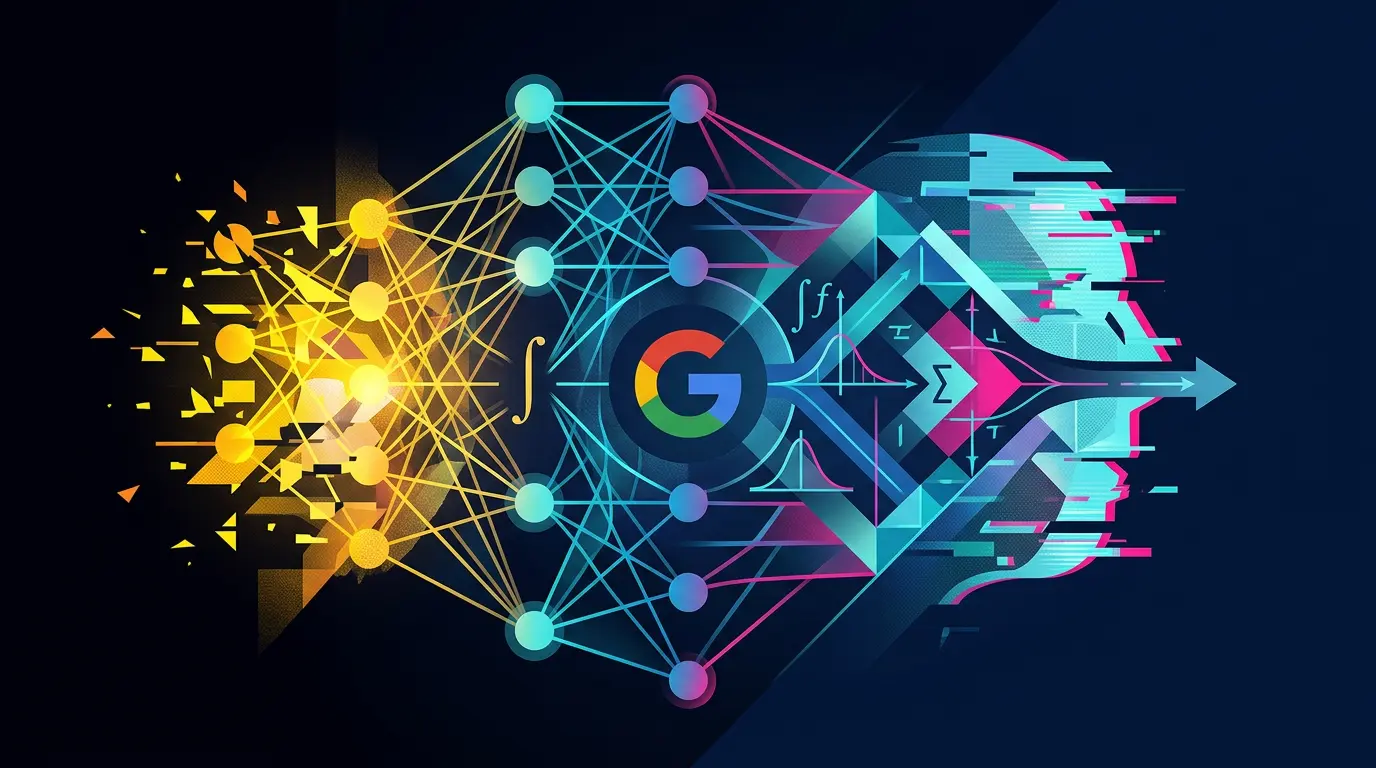
Recent reports originating from research circles suggest that Google is exploring a way out of this trap. A new methodology called Bayesian Teaching is circulating through the community, and it represents a fundamental change in how we think about machine learning. Instead of just shoving more data into a model and hoping it sticks, this approach uses Bayesian inference to refine the way models learn. It is a move away from blind guessing and toward a system that actually understands its own uncertainty.
The Problem With the Big Data Plateau
To understand why this matters, you have to look at how we train models today. We use gradient descent to minimize errors. It is a bit like trying to find the bottom of a valley while wearing a blindfold, where every step you take is based only on the slope of the ground beneath your feet. It works, but it requires an astronomical amount of computing power.
This method also creates a specific kind of failure. Because the model is trying to find a single set of optimal weights, it struggles with ambiguity. This is exactly why we see hallucinations. The model is forced to pick a path even when the data is thin or contradictory. We have tried to fix this by scaling up, adding more parameters and more tokens, but the energy costs are becoming unsustainable. We are essentially trying to build a better library by just piling more books in the town square without a cataloging system.
Enter Bayesian Teaching
According to details emerging from a recent Reddit discussion among AI specialists, Google’s proposed Bayesian Teaching method flips the script. In a Bayesian framework, you do not just look for one right answer. You maintain a probability distribution over many possible answers.
In the context of teaching an AI, this means the training process becomes much more surgical. Bayesian inference allows a system to update its beliefs based on new evidence while accounting for what it already knows (or what it doesn't). Think of it like a tutor who does not just hand a student a massive textbook, but instead provides specific examples that resolve that student's exact points of confusion.
By optimizing the flow of information during the training phase, researchers hope to help models generalize better from less data. If a model can quantify its own uncertainty, it can theoretically avoid the trap of confidently stating falsehoods. It recognizes when the probability of an answer is low, and it adjusts its output accordingly.
Efficiency and the Death of the Stochastic Parrot
As someone who spends a lot of time looking at model benchmarks, the potential for data efficiency is what excites me most. We are quite literally running out of high quality human text on the internet to train these things. If Bayesian Teaching allows us to build a model with the reasoning capabilities of Gemini or GPT-4 using only a fraction of the data, the economics of AI change overnight.
This could lead to an architectural shift where models are smaller, more agile, and significantly more reliable. We might finally move past the era of the stochastic parrot (the idea that AI is just repeating patterns without logic) and into an era of probabilistic intelligence. A model that knows it is 60 percent sure of a fact is infinitely more useful to a developer than a model that is 100 percent sure of a lie.
A Necessary Reality Check
We need to maintain some healthy skepticism here. This research is currently being discussed in community forums and has not yet undergone the rigorous gauntlet of independent peer review or public benchmarking. We have seen many promising ideas in the lab fail to scale when they are applied to models with trillions of parameters.
There is also the question of how this compares to Reinforcement Learning from Human Feedback (RLHF). Currently, RLHF is the primary tool we use to keep models on the rails, but it is a manual and often biased process. Whether Bayesian methods can replace or significantly augment RLHF remains to be seen. The burden of proof is on Google to show that this is not just a theoretical curiosity but a practical tool for the next generation of production models.
For now, the AI community is in a wait and see mode. But the shift in focus is telling.
The conversation is moving away from size and toward sophistication. We are no longer asking how much data we can cram into a transformer. We are asking how we can teach it to think about what it knows. If Google can successfully implement these probabilistic principles, we might be looking at the end of the brute force era. The question is no longer how big the model is, but how smart the teacher has become. Will we soon see AI that can finally admit when it doesn't have the answer?