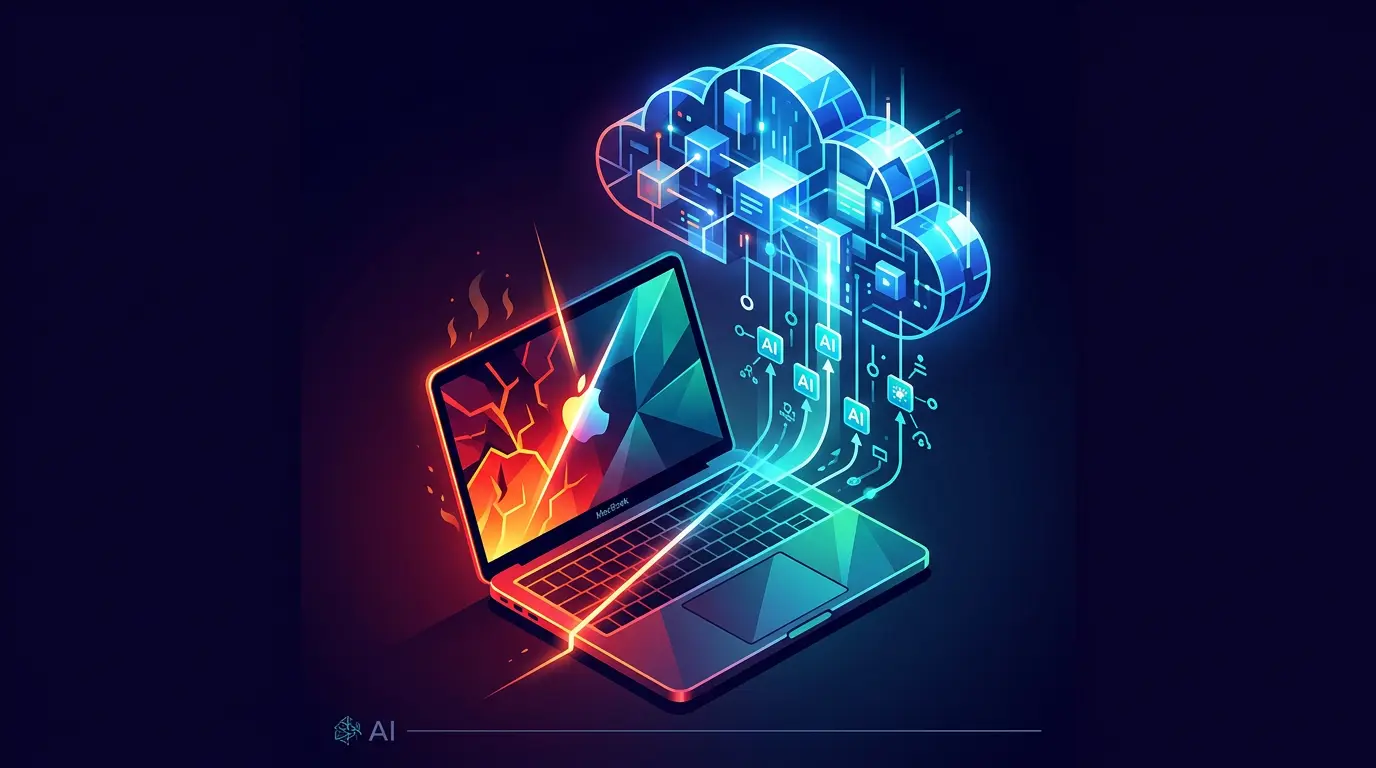
Your expensive laptop is screaming, but it is not because of an 8K video render or a high-end game. It is likely just a small AI agent trying to figure out why its Python dependencies are a mess. If you have ever watched your fans hit max velocity while an LLM attempts to scaffold a basic project, you have felt the friction. For the next generation of AI development, local hardware is no longer the engine. It is the bottleneck.
Google recently addressed this specific headache with the release of the Colab MCP Server. This tool acts as a bridge between your local development environment and the cloud infrastructure of Google Colab. By utilizing the Model Context Protocol (MCP), developers can now point their AI agents, such as Gemini CLI or Claude Code, toward a remote sandbox rather than their own physical hard drives. It is a fundamental shift in how we think about where an agent actually lives.
The Hardware Ceiling: Why Agents Need More Than a Laptop
In the dev world, we often talk about the scaffolding tax. This is the time and compute power lost to the boring stuff, such as setting up virtual environments, installing heavy libraries like PyTorch, and managing local file paths. For a human, this is a minor annoyance. For an autonomous agent, it is a high-latency trap.
When you are prototyping locally with AI agents, their potential is often capped by your machine. Waiting for agents to scaffold projects or install dependencies slows your entire workflow. If your agent is trying to run a simulation or process a massive dataset, your local RAM can become a wall that prevents the model from finishing the job.
By offloading these tasks to Google Colab, you are essentially giving your agent a high-performance brain transplant. It no longer matters if you are using an M3 Max or a five year old Chromebook. The compute is happening elsewhere.
The Model Context Protocol: The Universal Translator
MCP is the vital component here. Developed as an open standard to allow AI models to interact with external tools and data sources, it functions like a universal translator. Before MCP, connecting a specific agent to a specific execution environment was a manual, bespoke job. You had to write custom connectors for every single tool.
The Colab MCP Server standardizes this process. It allows any compatible agent to see the Colab environment as a set of accessible tools. Whether you are using Anthropic’s Claude Code or Google’s own Gemini CLI, the interface remains the same. This interoperability is crucial because it prevents developers from getting locked into a single ecosystem. You can bring your own agent and simply plug it into Google’s infrastructure.
Security and Isolation: A Safer Way to Run Autonomous Code
There is a deeper, more practical reason to move agents off your local machine: safety. Letting an autonomous agent run code directly on your hardware is a bit like letting a stranger play with a loaded terminal. We have all seen models hallucinate library names or suggest commands that could, in theory, wipe a directory.
Running code in a sandboxed Colab environment provides a layer of physical and digital isolation. If an agent goes off the rails or tries to execute a command that would compromise a system, it is contained within a temporary cloud instance. The tool provides a secure sandbox, which is a massive relief for researchers who want to test agentic autonomy without risking their personal data or local system integrity. It is the difference between letting a stranger drive your actual car and giving them the keys to a rental with full insurance.
The Remote-First Shift in AI Development
We are witnessing the slow death of the idea that a developer needs a heavy workstation to do serious AI work. If the intelligence lives in the cloud and the execution happens in a cloud sandbox, the local machine becomes little more than a window into that process.
This shift allows for massive scaling. You could, in theory, have multiple agents working in multiple Colab sandboxes simultaneously, all controlled from a single terminal. This would be impossible on a local machine due to thermal throttling and memory limits. The Colab MCP Server is not just a utility. It is a sign that the industry is moving toward a decoupled architecture where the agent is portable and the environment is ephemeral.
Looking Ahead: The Thin Client Future
This release leaves us with a significant question about the future of hardware. If Google and other providers continue to optimize these remote execution layers, does the developer laptop eventually become a thin client? We might be entering an era where the most important spec on your computer is not its GPU core count, but its network latency to the nearest data center.
While the speed and security of this sandbox are the primary selling points, we will eventually need to see hard benchmarks. We need to know how much latency the MCP layer adds to a code execution loop and how the cost of cloud compute compares to local electricity and hardware wear over a long project. For now, the Colab MCP Server is a clear signal that the cage door for local AI agents has finally been opened.