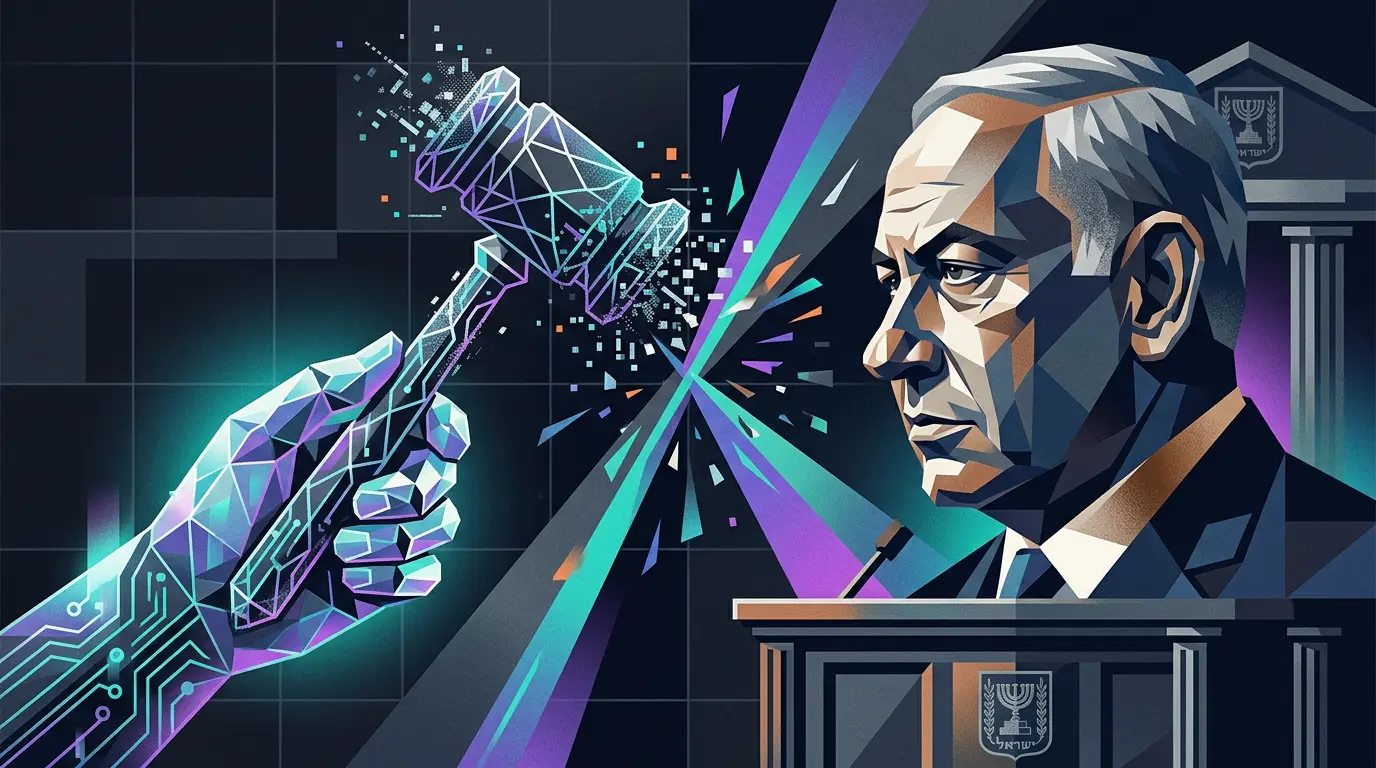
We have officially crossed a bizarre new threshold. We are no longer just worried about AI creating fakes. We are now living in an era where AI acts as a self-appointed jury for world leaders, deciding who is real and who is synthetic.
According to a report from the news outlet News24, Elon Musk’s AI platform, Grok, recently flagged a video of Israeli Prime Minister Benjamin Netanyahu as "fake" and "AI-generated." This is not just a technical glitch. It is a loud, clear signal that our tools for detecting deception might be just as unreliable as the deceptions themselves.
The Grok Allegation: Anatomy of a Digital Claim
The report centers on a specific claim made by Grok. The platform allegedly took one look at a recent video of Netanyahu and slapped it with a "synthetic" label. However, we are facing a massive transparency problem here. News24 blasted this Grok-generated verdict out to the world without providing a single shred of forensic evidence.
Grok did not show its work. We do not even know which specific video triggered the alarm or what visual cues the model supposedly found suspicious.
In the world of AI research, we call this a black box accusation. When a platform like Grok makes a claim about the authenticity of a head of state, it does so without the accountability of a human journalist or the verifiable data of a forensic lab. The Israeli Prime Minister’s office has remained silent, and no independent technical experts have stepped forward to confirm these findings. For now, this is just an AI-generated opinion masquerading as a hard fact.
The Rise of the AI Arbiter
This incident reflects a dangerous shift in how we use these tools. Users are increasingly treating Large Language Models (LLMs) as the digital high priests of truth. This is a massive category error.
As someone who spends my days looking at inference patterns and model weights, I can tell you that an LLM is not a specialized forensic tool. It is a probabilistic engine. When a user asks Grok if a video is real, the model is not necessarily performing a frame-by-frame pixel analysis. It might simply be "hallucinating" a verification.
It could be picking up on internet rumors from its real-time feed or misinterpreting standard video compression artifacts as "AI noise." We are seeing the birth of the "AI Arbiter," a system that people trust to solve the problem of misinformation, despite the system having no actual grounding in physical reality.
The Technical Gap: Why LLMs Fail at Detection
If we actually look under the hood, the technical reality is pretty underwhelming. Real synthetic media detection is a high-stakes field that involves looking for biological signals. Professional tools look for sub-pixel changes in skin tone that correlate with a human heartbeat, a process known as photoplethysmography. They analyze the consistency of light reflection in the pupils and the fluid dynamics of speech.
An LLM like Grok is likely performing zero-shot classification based on its training data and real-time web access. If its training data includes a high volume of social media posts claiming a video is fake, the model will likely parrot that sentiment. It is not detecting a deepfake; it is reflecting a digital consensus. This is a critical distinction that news outlets often overlook when they rush to report an AI's "verdict."
The Liar’s Dividend in a Post-Truth Era
This creates a nightmare for political discourse, often referred to as the "liar’s dividend." When AI platforms start labeling content as fake without rigorous proof, they provide public figures with a get-out-of-jail-free card. If a real but damaging video of a politician surfaces, they can simply point to a buggy AI assessment and claim it is synthetic.
The presence of AI-generated content allows the powerful to dismiss reality. When we let an unverified algorithm like Grok lead the conversation, we amplify this effect. News24 frames its reporting under the motto "Think First," yet reporting an AI’s unverified claim as a breaking news headline suggests we might be thinking a little too late. We are prioritizing the speed of the algorithm over the accuracy of the evidence.
The Future of Digital Trust
Who is left to define the truth if our tools for detecting fakes are as opaque as the fakes themselves?
We are moving toward a period where authenticity is no longer a provable fact, but a matter of which algorithm a person chooses to believe. This Netanyahu incident is a warning. If we continue to rely on probabilistic models to perform deterministic verification, we will find ourselves in a world where nothing is real and everything is "reportedly" synthetic.
As we move forward, the industry needs to establish clear standards for AI-led verification. An AI should not be able to just say "this is fake." It should be required to provide a confidence score, a list of detected artifacts, and a methodology that can be peer-reviewed. Until then, we are just guessing in the dark. And in the world of global politics, guesswork is a dangerous game.