Watching a humanoid robot try to navigate the world is usually an exercise in secondhand embarrassment. They are cautious, rigid, and perpetually one software hiccup away from a spectacular, metal on concrete faceplant. If you have ever seen a "state of the art" machine struggle with a doorknob, you know the aesthetic. It is less Olympic athlete and more toddler in a suit of armor.
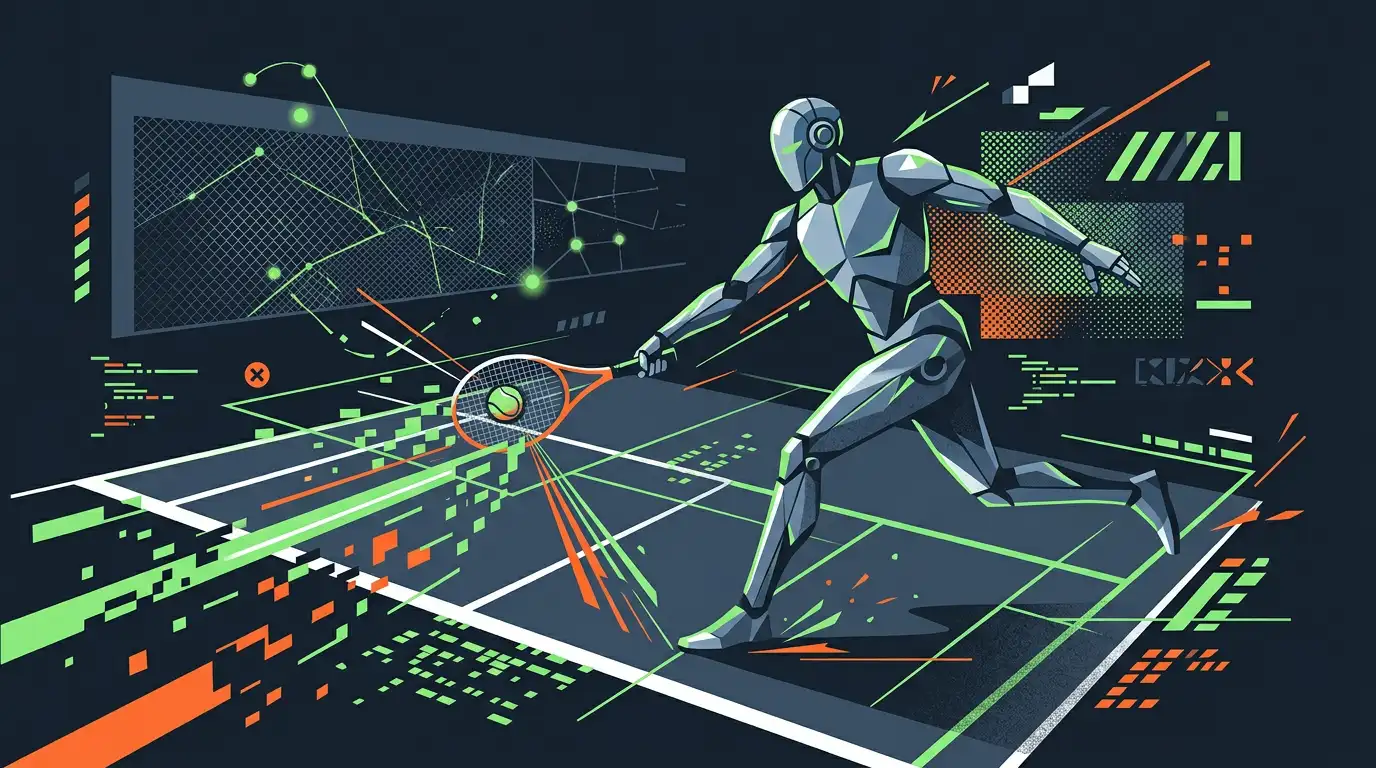
A new research project dubbed LATENT (Learning Athletic Humanoid Tennis Skills) suggests we might finally be done with the era of the stiff legged shuffle.
Researchers from Tsinghua University, Peking University, Galbot, the Shanghai Qi Zhi Institute, and the Shanghai AI Laboratory joined forces to solve a persistent headache in the field. How do you teach a robot to move like a pro athlete when the data you are feeding it is, to put it mildly, a bit of a mess?
The Problem with Perfection
AI researchers often fall into the trap of seeking perfect datasets. They want high fidelity, noise free motion capture where every joint angle is mapped to the millisecond. But the real world is rarely that clean. Sensors glitch, bodies get in the way of cameras, and human proportions do not always translate perfectly to titanium limbs. When you train a model on pristine data, it tends to shatter the moment it encounters the friction and chaos of reality.
This is where the LATENT framework flips the script. The team, led by equal contributors Zhikai Zhang, Haofei Lu, and Yunrui Lian, focused on training humanoid agents using "imperfect" human motion data. They are not just asking the robot to mimic a person. They are asking it to interpret the intent behind a movement and adapt that logic to its own physical constraints. This is a technical hurdle that has historically kept humanoids stuck with simple tasks like moving boxes rather than playing dynamic sports.
Why Tennis is the Ultimate Stress Test
Choosing tennis as a benchmark was a calculated, brilliant move.
Unlike walking or picking up a box, tennis requires a level of spatial awareness and split second decision making that pushes current models to their absolute limits. You have to track a ball moving at high speed, position your entire mass to generate force, and execute a swing with millisecond precision. It is the ultimate test of full body coordination.
From a research perspective, LATENT proves that a humanoid can handle these unpredictable environments. By successfully overcoming motion capture noise and physical hardware limitations, the researchers have created a blueprint for athletic robotics. This goes beyond the court. It is about building machines that can move with human-like grace in any chaotic setting, from a crowded hospital ward to a disaster recovery site.
A Massive Collaborative Effort
This was not a solo flight. The sheer scale of the institutional backing (Tsinghua, Peking, Galbot, and the Shanghai AI Lab) highlights how serious the industry is about this transition. Corresponding author Li Yi and the rest of the team have made their findings and methodology publicly accessible via GitHub. This open access model is vital. It allows the broader robotics community to build upon this framework rather than reinventing the wheel in isolated labs.
The system does not just copy a tennis swing. It understands the physics of the game. When the input data is noisy or low quality, the model fills in the gaps rather than failing. This suggests a level of underlying intelligence that makes previous versions of athletic AI look like simple programmed macros.
A New Era of Athleticism
We are currently seeing a shift from robots that do tasks to robots that possess skills. It is a subtle but vital distinction. A task is a series of programmed steps. A skill is a learned ability to adapt to a changing environment. By mastering the tennis court, these humanoid agents are proving they can handle the physical chaos of our world.
As we look toward the future, the implications are massive. If a robot can learn the complex weight shifts and timing required for a tennis serve from imperfect data, the ceiling for what else it can learn is incredibly high. We might soon see robots that can navigate uneven forest trails with the fluidity of a trail runner or assist in delicate medical procedures with the steady hand of a veteran surgeon.
The tennis court is just the starting line. The real question is whether we are ready for a world where machines eventually move with more grace than we do.