Benjamin Netanyahu recently sat in front of a camera lens for a reason that had nothing to do with military strategy or policy shifts. He was there to prove his own biological existence.
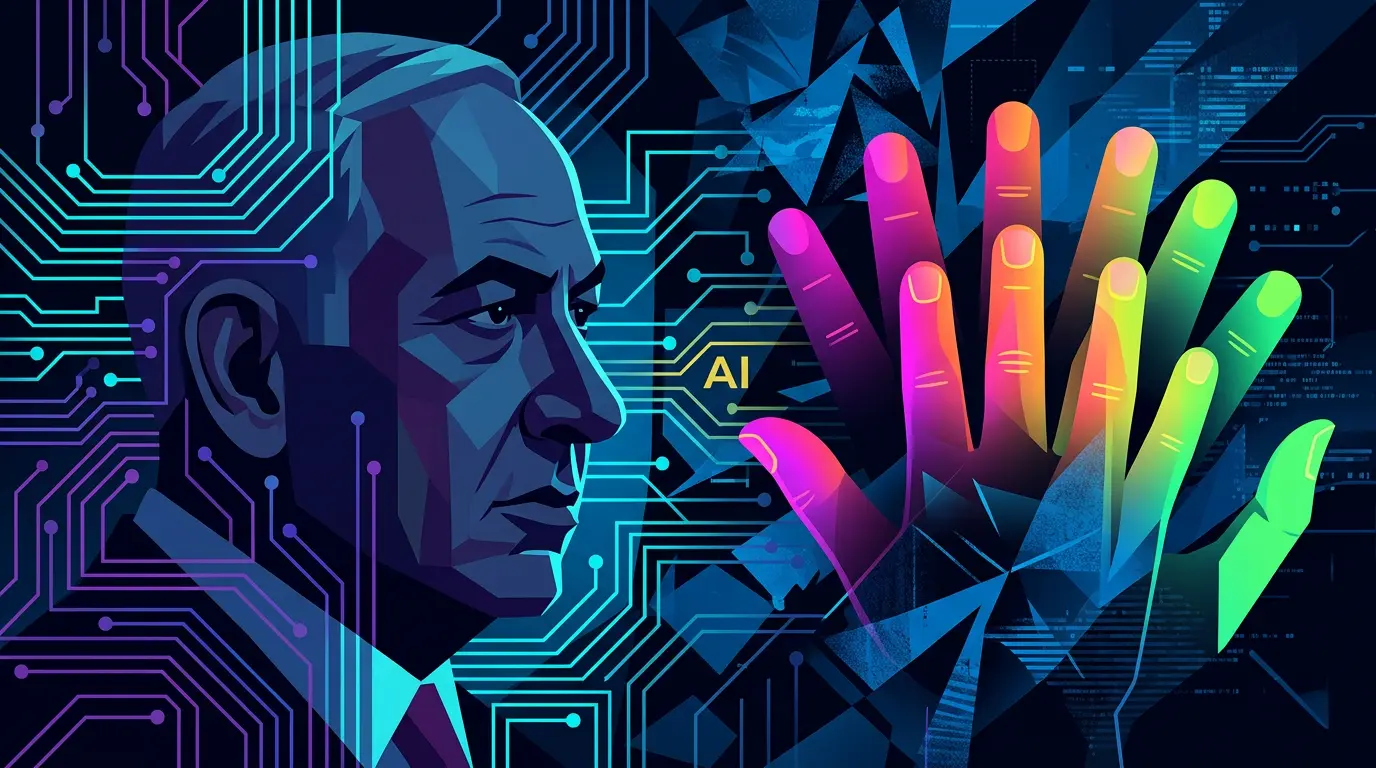
The Israeli Prime Minister held up both hands and spread his fingers wide for the world to see. One, two, three, all the way to ten. It was a surreal piece of performance art necessitated by a global audience that has collectively begun to doubt the evidence of its own eyes.
This odd display was a direct response to a viral conspiracy theory claiming Netanyahu had been killed following an Israeli strike on Iran. The fuel for this fire was a single visual anomaly in a previous video. Social media users, acting as amateur forensic analysts, pointed to a frame where the Prime Minister appeared to have six fingers. In the logic of the modern internet, this was not a compression artifact or a lighting glitch. It was definitive proof of a deepfake, a digital ghost standing in for a dead leader.
The Anatomy of a Digital Hoax
The timeline of this incident follows a pattern we are seeing more frequently in high-stakes geopolitics. Immediately following the strike on Iran, the information vacuum was filled with speculation. When the "six-finger" theory hit platforms like X and TikTok, it spread with the speed of a coordinated strike.
This specific type of hallucination (extra digits) is a well-known failure mode of early generative AI models like Midjourney or DALL-E. Because the public has been trained to look for these specific red flags, they now see them everywhere. Even when they aren't there.
We are witnessing the birth of a new kind of mass hysteria. In a high-tension environment, a technical glitch is no longer just a glitch. It is weaponized. The anomaly becomes the message. Whether the original "six-finger" video was a genuine technical error or a low-bitrate compression artifact remains unconfirmed, but the impact was undeniable. It forced a head of state to engage in a manual, low-tech debunking ritual.
The Low-Tech Counter-Offensive
There is a profound irony in Netanyahu using a physical gesture to combat a high-tech threat. By holding up ten fingers, he wasn't just showing he was alive. He was mocking the very idea that he could be a digital construction. He was performing a "humanity check," much like the CAPTCHAs we solve to prove we aren't bots.
This "show, don't tell" approach is becoming a necessary tool for information control. In the past, an official press release would suffice. Today, a leader must provide raw, unmistakable physical proof. It is an archaic solution to a futuristic problem.
However, the effectiveness of this response highlights a grim reality. We no longer trust the institutions that verify information. We only trust what we think we can verify ourselves, even if our own verification methods are flawed.
The Rise of AI-Paranoia
As a researcher who tracks the capabilities of generative models, I see this incident as a turning point. We have entered the era of the "Liar’s Dividend." This is a phenomenon where the mere existence of deepfake technology allows people to dismiss real events as fake. If any video can be a deepfake, then no video is inherently true.
Skepticism has been weaponized. It is no longer a tool for seeking truth but a shield against uncomfortable realities. In this case, the skepticism was used to fuel a death hoax, but it can just as easily be used to hand-wave away evidence of war crimes or political corruption. The burden on leadership has shifted. Modern communication strategies must now include a plan for digital verification that bypasses the screen and speaks directly to the viewer's most basic senses.
The Verification Gap
The most troubling aspect of this saga is the verification gap. While official sources and fact-checkers have confirmed Netanyahu is in good health, the original anomaly that started the fire remains a mystery. Was it a glitch in the matrix of a rushed edit? Or was it simply the way a shadow fell across a hand at thirty frames per second?
Distinguishing between a technological failure and malicious intent is becoming impossible in real-time. When the public stops believing what they see, the final arbiter of truth isn't data or evidence. It becomes whoever can shout the loudest or perform the most convincing physical stunt.
We are approaching a future where video evidence may no longer be considered proof of life. If a ten-finger gesture can be faked tomorrow, what will be the humanity check of next year? We are moving toward a world where truth is verified not by the image, but by the reputation of the source. It is a return to a more tribal form of information sharing. When we can't believe our eyes, what exactly do we have left to believe in?