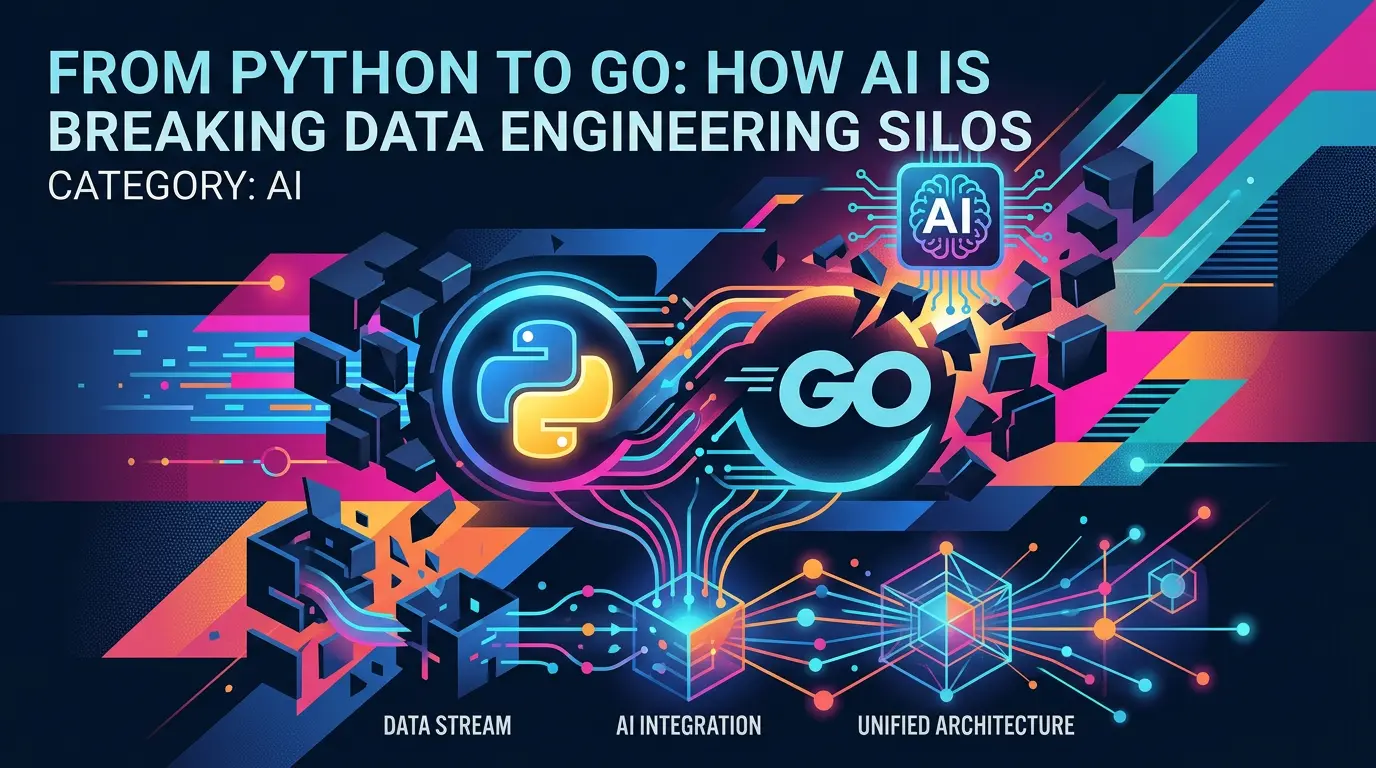
Data engineering has long been a tale of two cities. On one side, you have the Pythonistas and SQL enthusiasts who handle the logic. On the other, you find the systems engineers writing high-performance tools in Go or Rust. Historically, if you belonged to the first group and needed a hyper-specific tool for an operational headache, you had two choices. You could spend a month learning a complex new syntax, or you could open your wallet for another SaaS subscription.
That wall is finally coming down.
We are seeing a shift where Large Language Models act as a universal translator for architectural intent. According to practitioners in the field, data engineers are now using AI to build custom, lightweight tools that solve the exact "annoying" problems that off-the-shelf software usually ignores.
The New Force Multiplier: Breaking the Language Barrier
The most interesting development here is how AI allows engineers to jump between languages with almost zero friction.
A recent case from the community involved an engineer building a custom Command Line Interface (CLI) tool using Arrow Database Connectivity (ADBC). The twist? The tool was written in Go, a language the engineer didn't actually know.
"Something that wouldn't have happened before cause I don't know Go," the developer noted. This highlights how AI can bridge the gap between domain expertise and actual execution. We are no longer just talking about autocompleting lines of text. This is a fundamental expansion of what a single human can produce. When syntax is no longer a gatekeeper, the focus shifts entirely to the architecture and the logic of the data flow. It reduces the latency between an idea and a working prototype from weeks to a single afternoon.
The Utility Gap: Solving the Annoyances SaaS Can’t Reach
There is a clear strategic boundary emerging. While AI is excellent for building internal utilities, it is not ready to replace established platforms. You wouldn't use a chatbot to rebuild Snowflake or Fivetran from scratch. However, there is a massive "utility gap" between those giant platforms and the daily grind of a data team.
Data engineers are turning to AI for what I call Small Footprint Engineering. These are the niche, low-stakes automation tasks that do not justify a commercial license or a full development cycle.
Think of it as building a bespoke screwdriver for a single, weirdly shaped screw. It is nice to use, solves a specific friction point, and stays out of the way. By building these tools in Go, engineers get the performance of compiled binaries without the traditional overhead of learning memory management or concurrency patterns.
The Productivity Paradox: Gains vs. Reality
As someone who watches these models closely, I find the subjective nature of these wins fascinating. Users report feeling "more productive," but we have to ask a difficult question. Are we actually moving faster, or are we just generating more code to manage?
We have to be honest about the quality of this AI-generated code. While users might report a small code footprint, the actual maintainability and security of the logic have not undergone a third-party audit. This creates a potential black box effect. If an engineer builds a tool in Go using AI but does not understand the underlying implementation, they may be creating a ticking time bomb of technical debt. Right now, we are relying on anecdotal success stories rather than standardized metrics.
Redefining the Data Engineering Workflow
Despite the risks, the democratization of custom software is changing how data teams function. We are moving away from rigid, language-siloed workflows and toward a more fluid, tool-agnostic approach. The rise of standards like ADBC makes this even easier, providing a consistent way to interact with databases regardless of the language being used.
In this new world, the value of a data engineer is no longer tied to their fluency in a specific programming language. Instead, their value lies in their ability to prompt, validate, and integrate these AI-generated utilities into a cohesive ecosystem. The focus is shifting from "how do I write this" to "what should I build to make this pipeline better."
As data engineers become prolific creators of custom utility tools, will the industry face a future of technical debt sprawl? Or will the ability to rapidly replace AI-generated code usher in a new era of agile, disposable infrastructure?
If we can build a high-performance tool in an hour, we no longer need to maintain it for a decade. We can simply build a better one tomorrow. The real benchmark of success won't be how much code the AI writes, but how little of that code we actually need to keep.