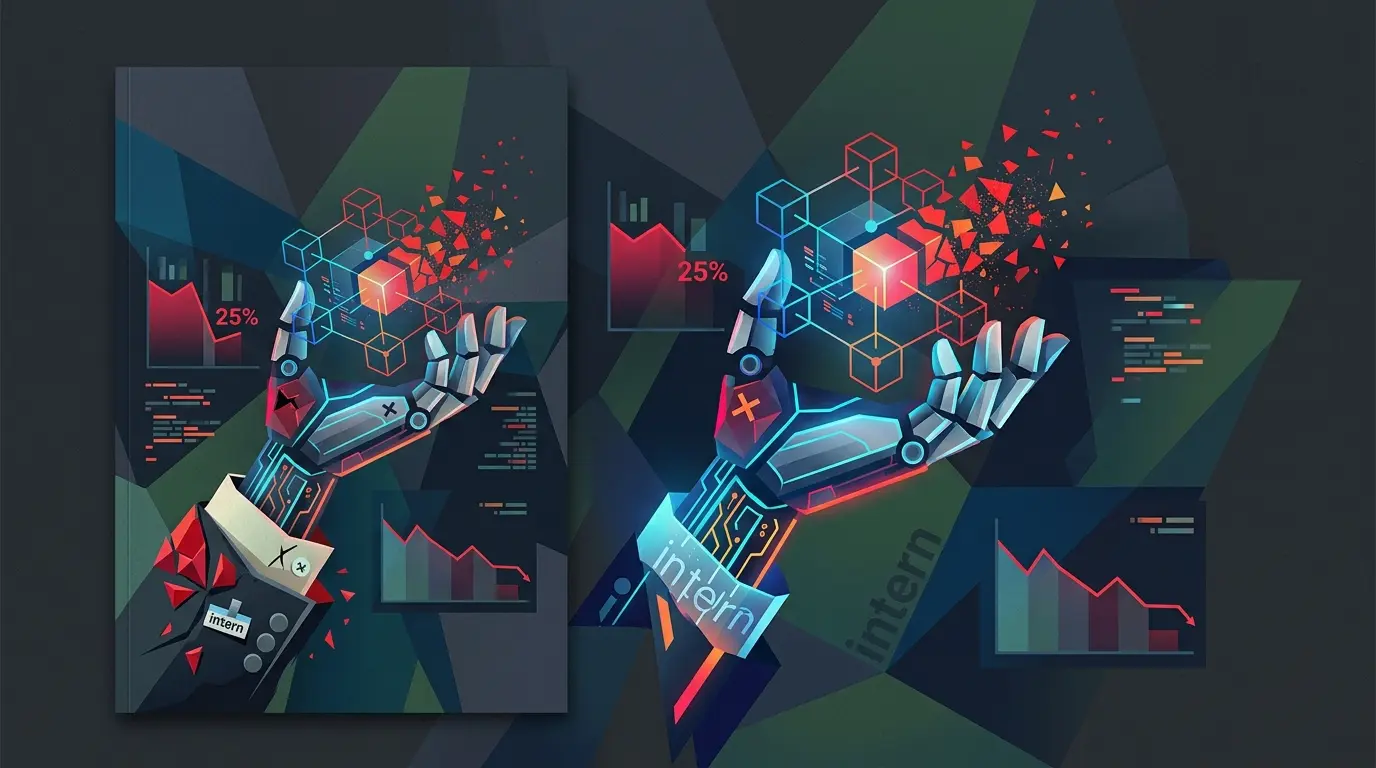
If you spend enough time reading white papers on neural networks, you get used to the scent of fresh benchmarks. Every week, a new model claims to have finally cracked the code on reasoning, math, or Python. But out on the loading docks, specifically within the grinding gears of global supply chains, the benchmarks that actually move the needle are measured in pallets and fuel. Right now, those numbers are telling a story that Silicon Valley isn't exactly tweeting about.
There is a massive disconnect between what a large language model can do in a lab and what machine learning actually does in a warehouse. While tech enthusiasts talk about autonomous agents managing entire global shipping lanes, the reality on the ground is much more modest. We are currently living in the era of the glorified dashboard. In this world, AI is used more as a mirror than a motor.
The Dashboard Trap
For the last few years, the logistics sector has been obsessed with "visibility." This obsession birthed a wave of software that promised AI-driven insights. In practice, most of these tools are just expensive data visualization platforms. They take your historical data, run some basic pattern recognition, and present it on a clean interface.
I call this descriptive AI. It tells you that your shipment is late or that your inventory is low. It might even use a colorful chart to show you why it happened. From a research perspective, however, this is barely scratching the surface of true intelligence. A dashboard is passive. It requires a human to look at it, interpret the data, and make a call. The actual "intelligence" remains outside the system, trapped in the brain of a logistics manager who is likely already overworked.
A Reality Check from the Front Lines
Niraj Jha, the Senior Director of Logistics-Southwest at Niagara Bottling, recently offered a sobering assessment of this dynamic. When asked if AI is truly making its mark in the supply chain today, his response was immediate and blunt.
"The short answer is not yet," Jha says.
That is a heavy statement coming from an executive at a company the size of Niagara Bottling. It suggests that despite the billions of dollars poured into supply chain startups, the core operational needle hasn't moved as much as the marketing brochures claim. Jha notes that the industry is still trying to figure out how to move past the reporting phase. There is a "longer answer" involving the potential for AI, of course, but for now we are stuck in a holding pattern where the technology is a spectator rather than a participant.
From Visualization to Decision Engines
To bridge this gap, we have to move toward what Jha describes as decision engines. In the world of AI research, this is the transition from perception to action. It is one thing for a model to identify a cat in a photo. It is an entirely different challenge for a model to decide how to steer a car to avoid that cat while maintaining safety protocols.
In a supply chain context, a decision engine doesn't just show you a red bar on a chart when a port is congested. It identifies the congestion, calculates the cost of delay versus the cost of rerouting, checks the availability of alternative carriers, and then executes the change autonomously.
This requires a level of confidence in the model's output that simply does not exist in most enterprise settings today. We are essentially waiting for the industry to move from "System 1" thinking (which is reactive and pattern-based) to "System 2" thinking (which is deliberative and goal-oriented). The technical hurdles are massive. Real-world logistics data is often noisy, siloed, and incomplete. You cannot train a high-stakes decision engine on data that is fundamentally broken.
The Wrapper Problem
As someone who tracks model performance daily, I see a familiar pattern here. Just as we saw a flood of "AI wrappers" in the consumer space (basically thin interfaces over existing APIs) we are seeing "AI-washing" in logistics. Many companies are rebranding their old, rule-based software as AI to satisfy board members or attract fresh investment.
This creates a dangerous feedback loop. When these systems fail to deliver the promised efficiency, it leads to "AI fatigue" among executives like Jha. They become skeptical of the real breakthroughs because they have been burned by the fake ones. For AI to actually take hold in manufacturing, we need to stop focusing on the UI and start focusing on the underlying data integrity.
The Path Toward True Autonomy
The question isn't whether AI can manage a supply chain, but when we will actually trust it to do so. Companies like Niagara Bottling are waiting for a shift in maturity where the software moves from being a helpful assistant to a reliable operator.
This will require more than just better algorithms. It will require a total rethink of how data is collected on the factory floor and how those systems communicate with one another. Until then, we remain in the dashboard era. We are watching the data flow by, waiting for the moment when the machines don't just tell us we have a problem, but actually decide how to fix it.
Jha’s skepticism is well-earned, but the transition might be closer than the current state of the industry suggests. First, however, we have a lot of legacy code to delete.